A Comprehensive Chronological Index of Published Works (2026–2017)
Interdisciplinary researcher & development practitioner at ULAB — covering disinformation, migration, climate, democracy, and digital rights across South Asia.
33Articles
9+Publishers
2017First Published
2026Latest
Showing all 33 articles
Author Profile Overview
Zulker Naeen is an interdisciplinary researcher and development practitioner at the University of Liberal Arts Bangladesh (ULAB). He serves as a Research Coordinator at the Centre for Critical and Qualitative Studies (CQS) and as an Adjunct Faculty member in the Department of Media Studies and Journalism. His research spans Digital Media and Information Studies, Synthetic Media Studies, Digital Literacy, and their intersections with gender, democracy, and civic participation. He is also Research Coordinator at FactWatch and a South Asia Fellow of the Climate Tracker network.
Zulker Naeen is a freelance journalist who usually writes on environmental and climate change issues.
He covers stories of climate change-induced food insecurity, natural disasters, and migration. As a citizen of one of the most climate-vulnerable nations, he works closely with the Climate Tracker to report climate resiliency for children and grassroots women.
He is actively involved with the Climate Tracker South Asia network, which makes him an environmentally conscious youth.
Zulker is also one of the South Asia Fellows under Climate Tracker, a global media network of Climate Change.
Zulker is one of the Train the Trainer Certified Journalists, can offer any effective climate change communication, empower qualified journalists to deliver training on the major climate journalism topics and establish a certification process for journalists.
He has a master’s degree in Communications and a bachelor’s degree in Media Studies and Journalism from the University of Liberal Arts, Bangladesh.
He has contributed to many course developments with the support of other Climate Tracker staff. As a young climate advocate, his fellowship aims to share knowledge of climate change.
Communicating Climate Change is to promote knowledge on climate change issues and to cover journalism skills. We’re opening this extensive course to prepare the next climate journalist.
Zulker Naeen is launching a course to prepare the next generation of journalists to promote Climate Journalism in Bangladesh.
Published Articles by Zulker Naeen
Here are the published stories by Zulker Naeen.
He focuses his writings on renewable energy, climate and health, energy access, energy democracy, climate migration, loss and damage, solar irrigation, and vector-borne disease.
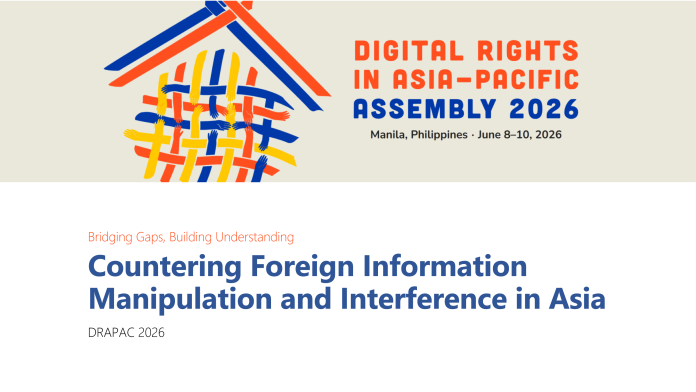
Bridging Gaps, Building Understanding: Countering Foreign Information Manipulation and Interference in Asia
Room 404 at the University of the Philippines held something rare on June 10, 2026 — a genuinely cross-regional reckoning with one of democracy’s most invisible threats. As part of DRAPAC 2026, themed “Building the Commons: Scaling Collective Resources for Our Digital Futures,” Doublethink Lab and Tempo co-hosted a landmark panel discussion titled “Bridging Gaps, Building Understanding: Countering Foreign Information Manipulation and Interference in Asia.”
Experts from Bangladesh, Indonesia, Taiwan, India, and the Philippines filled the room — each carrying field evidence that separately alarmed and together confirmed a regional pattern too consistent to dismiss.
Setting the security frame
Retired Rear Admiral Rommel Jude Ong of the Ateneo School of Government opened the security lens decisively. He argued that FIMI is not a communications failure — it is a deliberate, structured attack on national sovereignty. Drawing from his research on Chinese political warfare, he repositioned the conversation firmly within defence and security frameworks rather than media studies alone.
Janina Santos of Doublethink Lab reinforced this framing with operational precision. Her investigations revealed how state-linked actors — primarily China and Russia — deploy coordinated inauthentic behaviour across Asian platforms, timed deliberately around elections and civil unrest to maximise societal disruption.
Voices from the field
Ika Ningtyas of Tempo brought Indonesia’s lived experience into focus. She documented how health and political disinformation mutually reinforce each other, eroding both institutional trust and civic participation. Her decade-long journalism career gave her findings an immediacy that research alone rarely achieves.
From India, Rohit Sharma of ThinkFi demonstrated how AI and open-source intelligence tools now expose influence operations that previously went undetected. He showed concrete examples of fifth-generation warfare tactics targeting South and Southeast Asian democracies simultaneously.
Zulker Naeen from Bangladesh’s Centre for Critical and Qualitative Studies added a dimension others had acknowledged but rarely examined in depth — the disproportionate targeting of women voters, minority communities, and migrant-connected populations during Bangladesh’s 2026 national elections. FIMI, he argued, exploits existing social fractures with surgical precision.
Jerry Yu of Doublethink Lab and Dana Batnag of Democracy.Net.PH then connected individual country findings to a broader architecture of manipulation — one that crosses borders as fluidly as internet traffic does.
Rights at the centre
Throughout the discussion, FactLink’s Lia Peng guided the panel toward a critical conclusion. Countering FIMI cannot justify restricting expression. Every proposed intervention must anchor itself in fundamental freedoms — online and offline — or risk becoming the very threat it opposes.
A shared infrastructure for defence
What DRAPAC 2026 made unmistakably clear is this — no single country can outpace a threat that operates regionally. Cross-border intelligence sharing, whole-of-society coalitions, and rights-based frameworks are not aspirational language. They are operational necessities.
The commons Asia needs to build starts exactly here — with conversations like this one.
When Disinformation Becomes a Security Threat: A Bangladeshi Researcher’s Takeaways from DRAPAC 2026
Manila already carried the weight of history before the delegates arrived. On June 10, 2026, the University of the Philippines became the meeting ground for something urgent — a conversation about how democracies across Asia are losing a war most citizens cannot see. DRAPAC 2026, themed “Building the Commons: Scaling Collective Resources for Our Digital Futures,” brought together researchers, journalists, and security professionals from across the region. Bangladesh had a voice in that room.
As Research Coordinator at the Centre for Critical and Qualitative Studies (CQS), I joined the panel “Bridging Gaps, Building Understanding: Countering Foreign Information Manipulation and Interference in Asia” to represent not just my institution, but the particular vulnerabilities of a country navigating democratic fragility in a high-pressure information environment.
FIMI is not just fake news
Foreign Information Manipulation and Interference — FIMI — is not simply about false stories spreading online. The European Union External Action Service describes it as a security issue involving a structured supply chain. That distinction changes everything about how we respond.
In Bangladesh, the 2026 national election exposed this distinction sharply. Coordinated networks pushed narratives that were not always factually wrong — they were strategically misleading. The goal was not correction but confusion. Voter uncertainty, ethnic tension, and institutional distrust became the intended harvest. This is cognitive security under attack.
What Bangladesh brought to the table
My presentation drew from research at CQS on how FIMI operates at the intersection of migration, gender, and civic participation. Disinformation in Bangladesh does not target all communities equally. Women voters, minority communities, and migrant-connected populations face layered manipulation — content designed to suppress participation rather than simply spread falsehoods.
During the 2026 election cycle, we tracked coordinated inauthentic behaviour that amplified inflammatory content during key voting windows. The timing was not accidental. State-linked actors — operating from outside Bangladesh’s borders — clearly understood the country’s social fault lines better than most domestic observers wanted to admit.
A regional problem needs a regional response
What made this panel distinct was its refusal to treat each country’s FIMI problem as isolated. Researchers from Indonesia, Taiwan, India, and the Philippines brought their own case studies. Patterns emerged quickly. The tactics — platform manipulation, fabricated personas, emotionally charged micro-targeting — transcended national borders. The threat actors frequently did too.
Doublethink Lab’s digital investigations, Tempo’s fact-checking architecture, and ThinkFi’s AI-driven OSINT research all pointed toward the same conclusion: national responses alone are structurally insufficient. Cross-regional intelligence sharing is no longer optional.
Perhaps the most important thread running through our discussion was this — countering FIMI cannot become a justification for restricting expression. Bangladesh is currently navigating proposed disinformation legislation that carries real risks to press freedom. Any intervention must protect the rights it claims to defend.
The DRAPAC conversation reinforced something researchers and civil society across Asia increasingly agree on: a whole-of-society approach, rooted in fundamental freedoms, is the only sustainable path forward.
Leaving Manila with more than notes
Walking out of Room 404 that afternoon, the urgency felt sharper and the path forward slightly clearer. Bangladesh is not peripheral to this conversation — it sits at a critical intersection of Asian information dynamics.
Bringing that perspective into a regional framework is not just academically valuable. Given what is already happening, it is necessary.
Bridging Research & Practice in Disinformation Studies and Digital Citizenry
Scholarship & Practice — South Asia
When Displacement Moves Online: Zulker Naeen’s Work on Statelessness, Migration, and Refugee Voice in South Asia
For Zulker Naeen, a humanitarian crisis doesn’t end at the border — or at the screen. His interdisciplinary work follows the Rohingya, Bangladeshi migrant workers, and other displaced communities into the digital spaces where their stories are increasingly rewritten without them.
Feature profile · Displacement, Digital Rights & Migration Studies
A Crisis That Moved Online — and Kept Moving
Think about the last viral story you saw about the Rohingya. Where did it come from? Who framed it? And who was missing from it altogether?
These are the questions that shape Zulker Naeen’s research and journalism. When the Rohingya crisis intensified in 2017, the conversation around it didn’t stay in Myanmar or Bangladesh — it spread rapidly across social media platforms, news sites, and messaging apps in India, Indonesia, Pakistan, and beyond. What spread wasn’t always accurate. And what it left behind, in many cases, was something more dangerous than silence: a story told entirely by others, in which the Rohingya were no longer victims fleeing persecution but threats to be managed.
Naeen calls this the victim-to-threat narrative. Understanding how it forms, spreads, and hardens into public opinion has become the central thread running through his body of work — a portfolio that sits at the crossroads of journalism, migration studies, and digital rights research across South and Southeast Asia.
What makes the argument particularly sharp is what it claims about consequences. Naeen doesn’t treat this narrative as merely offensive content. He frames it as a threat multiplier: a set of stories that fuel real diplomatic friction between neighbouring states, provide political cover for harsh border policies, and widen the gaps in digital rights frameworks that were already poorly equipped to protect people with no citizenship to rely on.
This idea, that statelessness has both a physical and an informational dimension, runs through everything Naeen produces. It connects his academic papers to his journalism and his journalism to the training programmes he builds for working media professionals.
From Journal to Newsroom — and Back Again
One of the more striking features of Naeen’s portfolio is how fluidly it moves between theory and practice. His research findings don’t stay locked inside academic journals; they generate reporting, and that reporting generates new questions that feed back into research.
A good example is the phrase “from statelessness to digital voicelessness” itself. Naeen first used it as a conceptual frame in his journalism — specifically in a September 2025 piece for Global Voices that examined how anti-immigrant disinformation actively silences Rohingya communities in online spaces. A few months later, in December 2025, he followed it with a deeper investigation into what drives anti-immigrant discourse targeting stateless Rohingya in India — tracing how footage and images from Cox’s Bazar refugee camps travel across borders and arrive in Indian social media feeds stripped of their original context.
By February 2026, that same phrase had become the title of a hands-on workshop at the Beyond Borders Asia 2.0 conference in Chiang Mai, Thailand — an event supported by the German Federal Ministry for Economic Cooperation and Development and hosted through Deutsche Welle Akademie’s Displacement and Dialogue Asia programme. More than seventeen journalists, editors, and media specialists from across the region spent an hour working through concrete verification techniques for covering forced displacement, using the Rohingya case as their primary reference. Together, they drafted practical guidelines for ethical, inclusive reporting on refugee and migrant communities. The session didn’t just present research findings — it turned them into tools that participants could carry back into their newsrooms the following Monday.
Workshop at a GlanceFrom Statelessness to Digital Voicelessness: Fact-Checking Workshop for Media Professionals to Cover Forced Displacement
February 8, 2026 · Beyond Borders Asia 2.0 · Chiang Mai, Thailand
17+ participants from South and Southeast Asia · Co-created verification guidelines for reporting on displacement
Migration, Scams, and the Economics of Desperation
Alongside the Rohingya focus, Naeen maintains a parallel line of inquiry into Bangladeshi labour migration — and specifically into the digital vulnerabilities that trap aspirant workers long before they reach any border.
His study Root Cause Analysis of Digital Vulnerability of Bangladeshi Migrant Workers maps the mechanics of this problem at the village level — how recruitment scams and fraudulent payment platforms target people who are already economically precarious and digitally inexperienced, and how those scams translate into real financial loss, family debt, and in many cases dangerous migration conditions. The study goes further than diagnosing the problem: it proposes a participatory digital-literacy curriculum that could reduce harm at the point where it actually starts.
That academic work connects directly to two pieces of journalism. A feature for The Business Standard brought the scam economy into public view for a Bangladeshi readership. More recently, a Global Voices investigation traced Bangladeshi migrant smuggling networks operating across the Central Mediterranean route, estimating that this shadow economy could generate between two hundred and three hundred and forty million dollars in gross revenue if current patterns hold. The numbers are staggering — and they point toward a migration system that generates enormous profit for intermediaries while exposing migrants themselves to serious danger at every stage.
Regional Conversations — From Manila to Cox’s Bazar
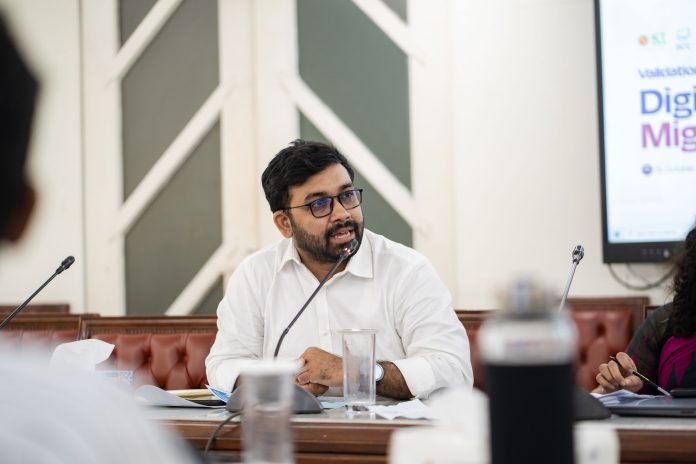
In June 2026, Naeen brought this regional perspective to Manila, joining a panel on Foreign Information Manipulation and Interference at DRAPAC 2026, hosted by Doublethink Lab and Tempo at the University of the Philippines. Alongside researchers from Indonesia, Taiwan, India, and the Philippines, he presented findings on how coordinated disinformation during Bangladesh’s 2026 national election fell heaviest on women voters, religious and ethnic minority communities, and families with ties to labour migration. His published reflection from that event argues that any serious regional response to foreign information manipulation needs to start with fundamental rights — not with new tools that could just as easily restrict legitimate expression as counter harmful campaigns.
Meanwhile, the physical conditions inside displacement itself remain part of the frame. An earlier study on fire incidents in the Rohingya refugee camps of Cox’s Bazar documented 2,425 fires between 2018 and 2025 — events that affected more than one hundred thousand people and repeatedly destroyed whatever shelter and belongings families had managed to hold onto. That research grounds the larger argument in the simplest possible terms: displaced people deserve the right to shelter that doesn’t burn, just as they deserve the right to a story that isn’t distorted.
One Question, Many Fronts
Taken together, the portfolio amounts to a sustained answer to a single question: what happens when displacement leaves a person without a state, and then digital systems leave them without a voice? The answer Naeen builds, piece by piece, is that both losses are connected — that the physical dispossession of statelessness and the informational dispossession of disinformation reinforce each other, and that addressing one without the other leaves the underlying problem intact.
His work spans research papers, long-form journalism, workshop design, conference panels, and fact-checking training — each format finding its own audience and its own way of putting pressure on the same problem. That range is, in itself, an argument: that the communities most affected by displacement deserve more than a single genre of attention.
Explore Zulker Naeen’s Published Work
Find his writing and research across the following platforms:
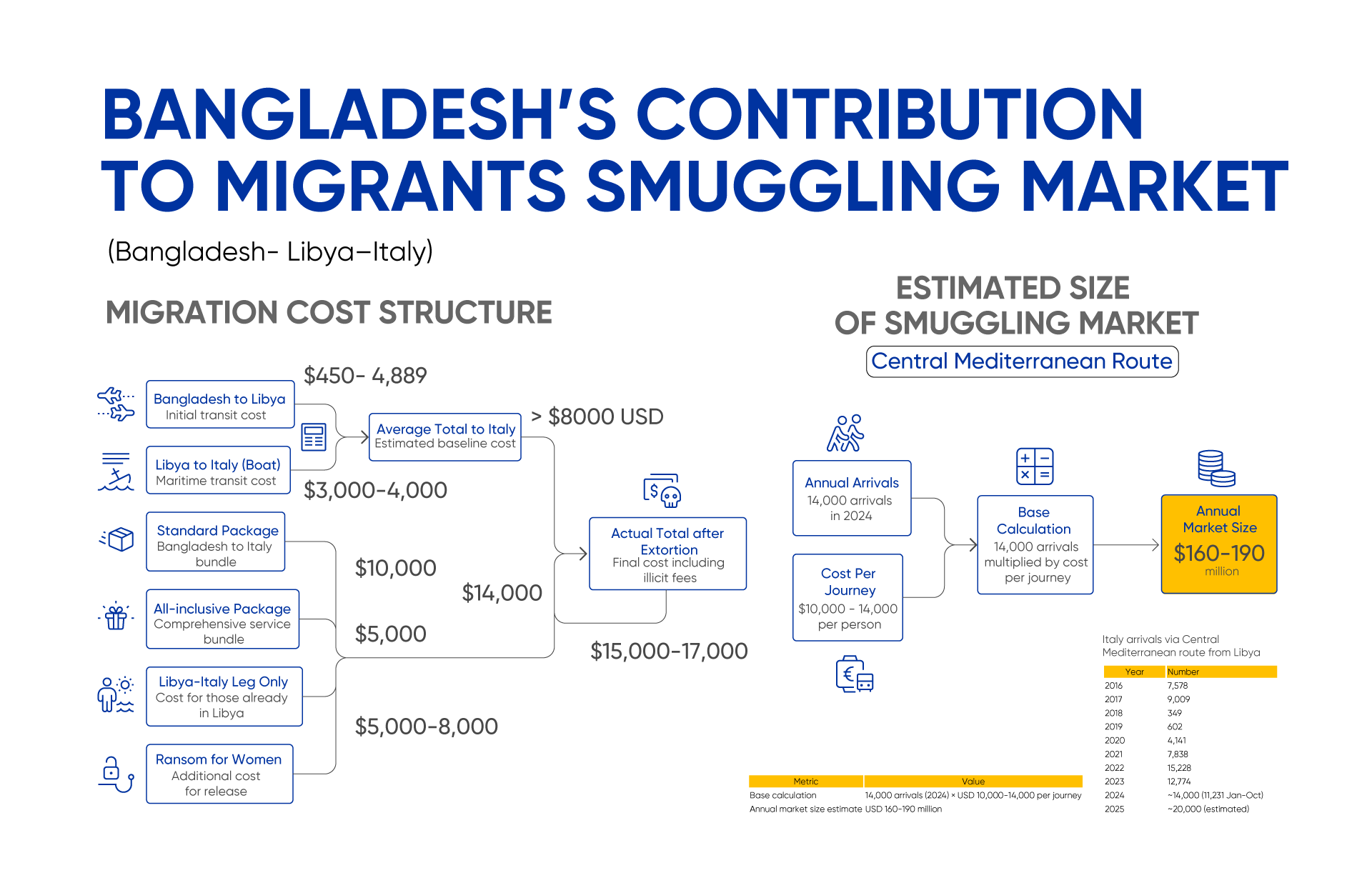
If the current growth rate of illegal migration continues—from approximately 14,000 arrivals in 2024 to an estimated 20,000 in 2025—and if per-person costs remain between $10,000 and $17,000, the smuggling economy could reach $200 to $340 million in gross revenue.
Author’s own illustration
Three years of construction work in Dhaka had accumulated to $6,500 in savings when the dalal (local broker) approached with a proposition that seemed almost too good to refuse. The route appeared straightforward: Bangladesh through Saudi Arabia to Libya, then a brief Mediterranean crossing to Italian shores, where monthly earnings could exceed what he made annually.
“From Bangladesh through Saudi Arabia to Libya, then from Libya attempting the boat crossing to Greece or Italy,” he recounted months later, describing what he believed would be a well-established pathway used by thousands before him.
However, upon reaching Libya, reality shifted dramatically. He spent three weeks in what smugglers called a “game house”—a holding facility where two hundred migrants waited for weather conditions and boat availability.
The promised boat finally arrived at night, overcrowded beyond any safety margin, with nearly one hundred and fifty people packed into a vessel designed for perhaps forty.
“We went with the hope of reaching Italy for a better future,” he said, remembering the moment the engine started and the Libyan coast began receding. “The boat ran for only twenty minutes before the coast guard caught us.”
Read more by clicking the article’s original link.
Originally published at GlobalVoices on June 6, 2026.
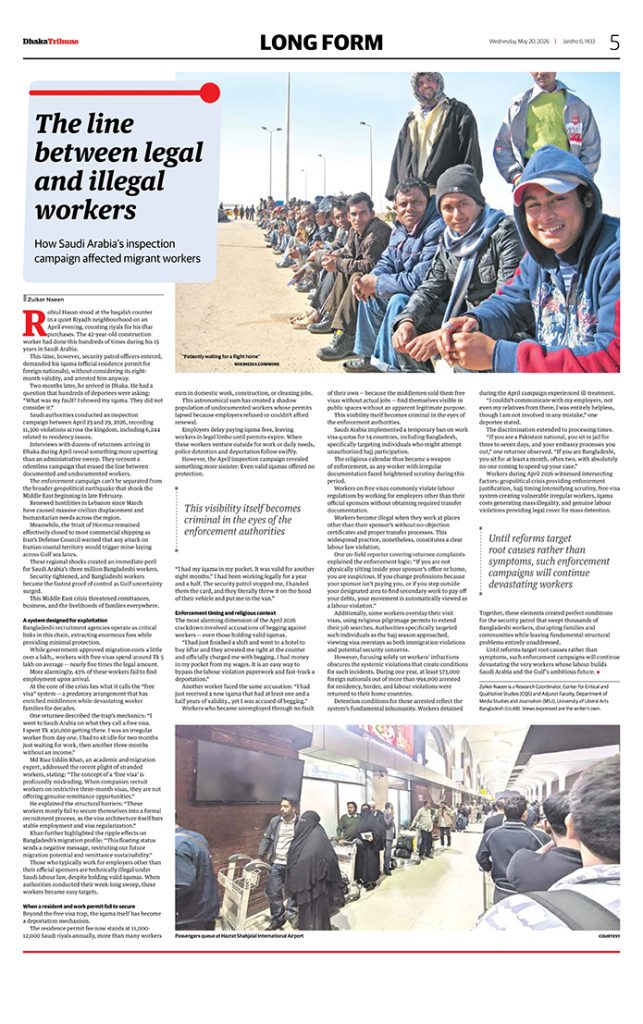
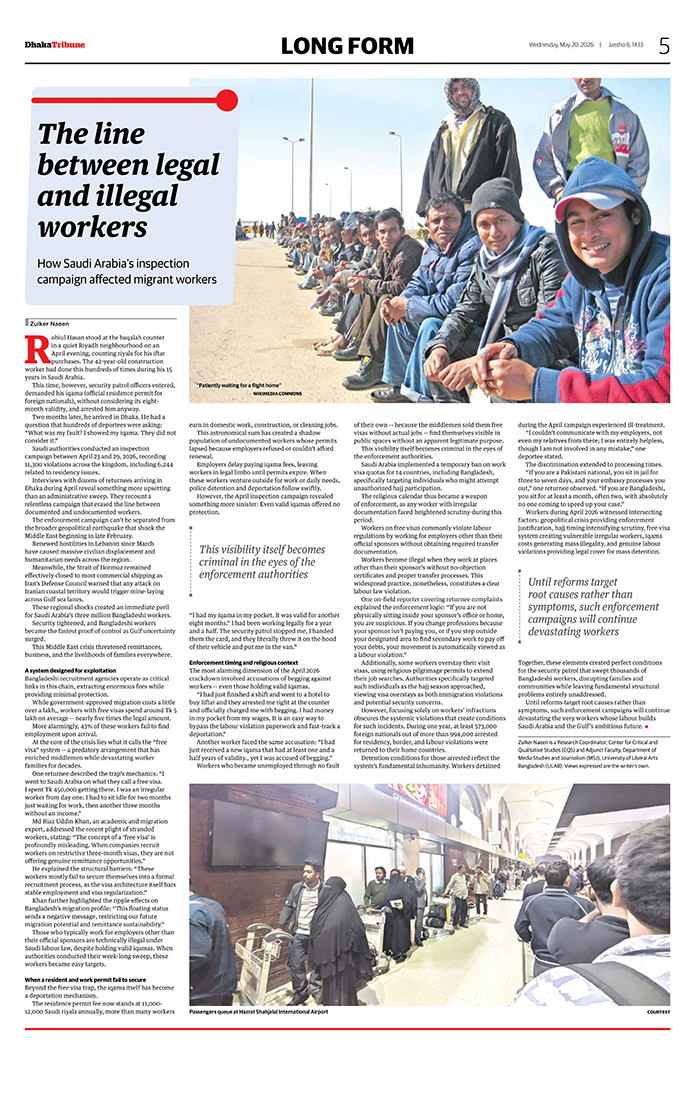
How Saudi Arabia’s inspection campaign erased the line between legal and illegal workers
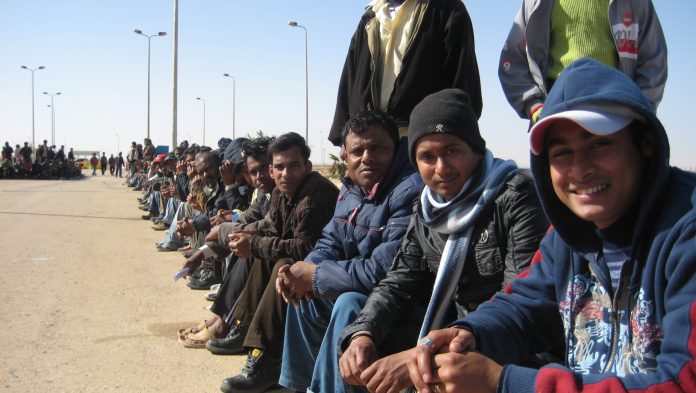
Robiul Hasan stood at the baqalah counter in a quiet Riyadh neighbourhood on an April evening, counting riyals for his iftar purchases. The 42-year-old construction worker had done this hundreds of times during his fifteen years in Saudi Arabia. This time, however, security patrol officers entered, demanded his iqama, without considering its eight-month validity, and arrested him anyway. Two months later, he arrived at the airport in Dhaka and a question that hundreds of deportees were asking: “What was my fault? I showed my iqama. They did not consider it.”
Saudi authorities conducted an inspection campaign between April 23 and 29, 2026, recording 11,300 violations across the kingdom, including 6,244 related to residency issues. Interviews with dozens of returnees arriving in Dhaka during this April reveal something more upsetting than an administrative sweep. They recount a relentless campaign that erased the line between documented and undocumented workers.
The enforcement campaign can’t be separated from the broader geopolitical earthquake that shook the Middle East beginning in late February. Renewed hostilities in Lebanon since March have caused massive civilian displacement and humanitarian needs across the region. Meanwhile, the Strait of Hormuz remained effectively closed to most commercial shipping as Iran’s Defence Council warned that any attack on Iranian coastal territory would trigger mine-laying across Gulf sea lanes.
These regional shocks created an immediate peril for Saudi Arabia’s three million Bangladeshi workers. Security tightened, and Bangladeshi workers became the fastest proof of control as Gulf uncertainty surged. This Middle East crisis threatened remittances, business, and the livelihoods of families everywhere.
Read more by clicking the article’s original link.
Originally published at Dhaka Tribune on May 20, 2026.
Slotexo Casino se distingue dans l’univers des jeux en ligne grâce à une offre de cashback des plus attractives. Accessible sur https://slotexofr.fr, cette plateforme combine une expérience utilisateur fluide et des incitations financières ciblées qui réussissent à attirer une vaste communauté de joueurs. Dans cet article, nous explorerons les principales offres de cashback et d’autres caractéristiques clés qui rendent Slotexo Casino irrésistible.
Les avantages du cashback chez Slotexo Casino
Le cashback est devenu un outil de fidélisation essentiel dans les casinos en ligne, et Slotexo ne fait pas exception. La plateforme propose des offres de cashback qui permettent aux joueurs de récupérer un pourcentage de leurs pertes sur une période donnée. Ce système incite à un jeu plus fréquent, tout en allégeant la pression financière.
Voici quelques points clés concernant l’offre de cashback de Slotexo :
Pourcentage de cashback flexible, allant jusqu’à 20% selon le statut du joueur.
Application automatique aux pertes éligibles sans condition complexe.
Limite de cashback mensuelle pour éviter les abus.
Possibilité d’utiliser le cashback pour des mises sur les jeux préférés.
Notification par email pour chaque cashback approuvé, assurant une transparence totale.
Un aperçu du catalogue de jeux
Le succès de Slotexo Casino repose également sur un vaste catalogue de jeux fourni par des éditeurs réputés. Les joueurs peuvent s’attendre à une gamme variée, incluant des machines à sous, des jeux de table, et même des options de casino en direct. Ce choix invite les joueurs à explorer et profiter de nouvelles expériences régulièrement.
Parmi les jeux les plus populaires, on trouve :
Type de jeu
Popularité
Éditeurs
Machines à sous
Élevée
NetEnt, Microgaming
Jeux de table
Modérée
Evolution Gaming
Live Casino
Élevée
Evolution, Pragmatic Play
La sécurité et la confiance des joueurs
La sécurité est une priorité pour Slotexo Casino, qui opère sous une licence reconnue, garantissant la protection des données et des transactions des joueurs. L’utilisation de protocoles de cryptage avancés assure que toutes les informations personnelles et financières restent protégées.
Le site se conforme aux normes de jeu responsable, en offrant des outils de gestion de jeu pour les joueurs souhaitant contrôler leur expérience de jeu. Cela renforce la confiance et la fidélité des utilisateurs envers la plateforme.
FAQ sur Slotexo Casino
Comment obtenir le cashback chez Slotexo Casino ?
Il suffit de jouer aux jeux éligibles, les pertes seront automatiquement prises en compte pour le calcul du cashback.
Quels types de jeux sont disponibles sur la plateforme ?
Slotexo propose une large sélection de machines à sous, jeux de table et un casino en direct, offrant des expériences variées.
Slotexo Casino est-il sécurisé ?
Oui, Slotexo Casino fonctionne sous une licence régulée et utilise un cryptage avancé pour protéger les données des joueurs.
La plateforme brutal casino app se distingue par une offre complète intégrant divers services répondant aux attentes des joueurs contemporains. Brutal Casino propose un environnement de jeu structuré autour de plusieurs piliers essentiels, dont la richesse de son catalogue, la robustesse de ses options de paiement et la qualité de son support client.
Catalogue de jeux : diversité et innovation au rendez-vous
Brutal Casino présente un large éventail de jeux couvrant plusieurs catégories majeures : machines à sous classiques et vidéo, jeux de table, jackpots progressifs et tables avec croupiers en direct. La plateforme collabore avec plusieurs fournisseurs réputés, ce qui assure une offre régulièrement mise à jour et techniquement performante.
Les nouveautés sont intégrées régulièrement, permettant d’accéder à des titres innovants, incluant des fonctionnalités modernes comme des modes bonus interactifs ou des mécanismes de gamification avancée. Cette diversité satisfait aussi bien les débutants que les joueurs expérimentés à la recherche de sensations variées.
Infrastructure de paiement : rapidité et variété des méthodes
La gestion des transactions chez Brutal Casino est conçue pour optimiser la fluidité des dépôts et retraits. La plateforme accepte plusieurs devises et intègre des moyens de paiement traditionnels (cartes bancaires, virements) ainsi que des solutions modernes, y compris des portefeuilles électroniques et des cryptomonnaies.
Les limites de transaction sont clairement affichées, avec une bonne flexibilité adaptée à différents profils de joueurs. La rapidité des traitements assure un accès rapide aux gains, améliorant ainsi l’expérience utilisateur globale.
Méthode
Délai de retrait
Devises prises en charge
Carte Bancaire
24-48h
EUR, USD
Portefeuilles Électroniques
1-2h
EUR, USD, BTC
Cryptomonnaies
Instantané à 1h
BTC, ETH, LTC
Support client : assistance multilingue et réactive
Le service clientèle de Brutal Casino propose un support disponible via live chat, e-mail et formulaire de contact. La prise en charge multilingue couvre les principales langues européennes, dont le français, ce qui facilite la communication et la résolution rapide des demandes.
Les temps de réponse affichent une bonne réactivité, contribuant à instaurer un climat de confiance. L’aide est pertinente aussi bien pour les questions techniques que pour les conseils liés aux règles de jeu, aux systèmes de bonus ou aux procédures de paiement.
Bonus et fidélisation : quels avantages pour le joueur ?
Brutal Casino offre un éventail d’incitations destiné à attirer et retenir les joueurs. Cela inclut des bonus de bienvenue, des promotions régulières, ainsi qu’un programme de fidélité proposant plusieurs niveaux avec des privilèges croissants.
Les conditions d’obtention et de mise des bonus sont clairement exposées, limitant les ambiguïtés. Ce cadre transparent favorise une expérience utilisateur sereine et motive les joueurs à maximiser leurs gains potentiels.
Bonus de bienvenue jusqu’à 300€ + 100 tours gratuits
Promotions hebdomadaires avec reload bonus
Programme VIP à plusieurs niveaux
Cashback mensuel pour joueurs réguliers
FAQ – Questions fréquentes
Quels sont les délais moyens pour les retraits ? Les délais varient de quelques minutes à 48 heures selon la méthode choisie.
Le site est-il sécurisé et légal ? Oui, Brutal Casino dispose de licences valides et utilise un chiffrement SSL pour protéger les données.
Peut-on jouer depuis un appareil mobile ? La plateforme est optimisée pour mobiles, et une application est également disponible pour iOS et Android.
Dans le monde des jeux d’argent en ligne, Kingdom Casino se distingue par sa diversité et ses nombreuses options d’accès pour les joueurs. Que ce soit sur desktop ou mobile, cette plateforme offre une expérience de jeu dynamique et captivante, répondant à un large éventail de préférences. Dans ce guide complet, nous explorerons comment accéder à ce casino en ligne et les diverses fonctionnalités qui fidélisent ses utilisateurs.
Modes d’accès à Kingdom Casino
Kingdom Casino propose plusieurs méthodes d’accès adaptées aux besoins de chaque joueur. La plateforme peut être atteinte à travers un navigateur web sur ordinateurs, ainsi que par son application mobile, disponible sur les systèmes Android et iOS. Les joueurs peuvent se connecter facilement en utilisant leurs identifiants ou créer un compte pour profiter de l’intégralité des services proposés.
Accès via navigateur : compatible avec tous les principaux navigateurs.
Application mobile : installation rapide, interface optimisée pour smartphones.
Code QR : possibilité de se connecter en scannant un code.
Jouer sans inscription : mode démo pour tester les jeux sans compte.
Support multi-langue : interface disponible en plusieurs langues, facilitant l’accès international.
Expérience utilisateur sur la plateforme
L’interface de Kingdom Casino est conçue pour être intuitive et agréable. Les nouveaux joueurs trouveront facilement les jeux grâce à une navigation fluide et un design épuré. Chaque section de la plateforme, des jeux aux promotions, est clairement indiquée et facilement accessible. De plus, Kingdom Casino propose une sélection variée de jeux fournie par des développeurs réputés, garantissant ainsi une expérience de jeu enrichissante.
Jeux offerts
La bibliothèque de jeux comprend des machines à sous, des jeux de table et des options de casino en direct. Les joueurs peuvent explorer différents types de machines à sous, des classiques aux nouveautés, ainsi que des jeux comme le blackjack, la roulette, et le poker. L’expérience en live, quant à elle, est immersive, avec des croupiers professionnels et les dernières technologies de streaming.
Type de jeu
Variété
Logiciels
Machines à sous
Plus de 300
NetEnt, Microgaming
Jeux de table
Roulette, Blackjack
Evolution Gaming
Offres et bonus attractifs
Kingdom Casino se démarque également par sa généreuse gamme de bonus et promotions. Les nouveaux joueurs peuvent bénéficier d’un bonus de bienvenue significatif leur permettant de commencer leur aventure avec une prime additionnelle. De plus, le site récompense la fidélité de ses utilisateurs avec un programme VIP, offrant des récompenses exclusives.
Foire aux questions
Quels sont les modes de paiement disponibles ? Kingdom Casino accepte les cartes de crédit, les portefeuilles électroniques, et propose également des options de crypto-monnaies pour des dépôts rapides.
Est-ce que Kingdom Casino est sécurisé ? Oui, la plateforme utilise un chiffrement avancé pour protéger les informations des utilisateurs et garantit un jeu responsable.
Y a-t-il une application mobile ? Oui, les joueurs peuvent télécharger l’application Kingdom Casino sur les appareils Android et iOS, offrant un accès facile à tous les jeux et fonctionnalités.
Das hot loot casino hat sich als eine der aufstrebenden Plattformen im Online-Gaming-Markt etabliert. Die Attraktivität dieser Plattform für Spieler lässt sich auf mehrere Schlüsselfaktoren zurückführen, die sie von anderen Anbietern abheben.
Umfangreicher Spielkatalog
Ein wesentliches Merkmal des HotLoot Casinos ist sein umfangreicher Spielkatalog. Die Plattform bietet eine Vielzahl von Spielen, darunter Slots, Tischspiele und Live-Dealer-Angebote. Die Auswahl an Anbietern reicht von bekannten Namen bis hin zu innovativen Entwicklern, was die Spielerfahrung erheblich bereichert.
Über 1.500 verschiedene Spiele
Slots mit unterschiedlichen Themen und Jackpots
Live-Casino-Spiele mit echten Dealern
Attraktive Bonusangebote
Ein weiterer Grund, warum Spieler sich für HotLoot Casino entscheiden, sind die verschiedenen Bonusprogramme. Neue Spieler profitieren von großzügigen Willkommensboni, während Bestandskunden durch regelmäßige Promotions und ein Loyalitätsprogramm belohnt werden. Diese Boni erhöhen nicht nur die Gewinne, sondern auch die Spielzeit.
Bonusart
Details
Maximalbetrag
Willkommensbonus
Erster Einzahlungsbonus von 100%
bis zu 200 €
Einzahlungsbonus
Wöchentlicher Bonus bis zu 50%
bis zu 100 €
Benutzerfreundliche Plattform und mobile Erfahrung
Die Plattform von HotLoot ist nicht nur optisch ansprechend, sondern auch benutzerfreundlich gestaltet. Spieler finden sich schnell zurecht, und die Navigation durch die verschiedenen Spielkategorien ist intuitiv. Darüber hinaus ist die mobile Version der Webseite gut optimiert, sodass Spieler auch unterwegs problemlos spielen können.
Die Verfügbarkeit von Apps für iOS und Android macht das Spielen noch zugänglicher. Daher können Spieler jederzeit und überall auf ihre Lieblingsspiele zugreifen.
FAQ – Häufig gestellte Fragen
Wie sicher ist das HotLoot Casino? Das Casino ist lizenziert und setzt hohe Sicherheitsstandards, einschließlich SSL-Verschlüsselung, um die Daten seiner Spieler zu schützen.
Welche Zahlungsmethoden werden akzeptiert? Das HotLoot Casino bietet verschiedene Zahlungsmethoden, darunter Kreditkarten, E-Wallets und Kryptowährungen, um Einzahlungen und Auszahlungen zu erleichtern.
Gibt es ein Treueprogramm? Ja, HotLoot Casino bietet ein Treueprogramm, das Spielern Vorteile und Belohnungen für regelmäßiges Spielen bietet.