Home Blog Page 2

Zulker Naeen is an interdisciplinary researcher and development practitioner

0
Journalism
Zulker Naeen is an interdisciplinary researcher and development practitioner

Zulker Naeen is an interdisciplinary researcher and development practitioner whose academic formation and professional trajectory sit at the confluence of Media Studies, Journalism, Communication, and Development Studies.

He completed a Bachelor’s in Media Studies & Journalism and a Master’s in Communication at the University of Liberal Arts Bangladesh (ULAB). Later, he expanded his theoretical grounding with a Master’s in Development Studies from the Independent University, Bangladesh (IUB), a combination that underpins his work bridging scholarly inquiry and field-facing practice.

Digital Citizenry
Bridging Research & Practice in Disinformation Studies and Digital Citizenry

This layered disciplinary foundation enables him to deploy communication theory, journalistic method and development frameworks in the analysis and design of interventions that address information disorder, civic literacy and grassroots problems.

As a faculty member in the Department of Media Studies and Journalism at ULAB and as Research Coordinator at ULAB’s Centre for Critical and Qualitative Studies (CQS), he teaches and mentors on courses that synthesize strategy, ethics and technique—Strategic Public Relations, Communications for Development, Critical Thinking and Logic, Fact-checking and Digital Forensics, and Independent Journalism—preparing students to move fluidly between newsroom practice, public-interest investigation and policy-relevant research.

His classroom practice is informed by hands-on verification work and project leadership carried out through Fact-Watch and regional collaborations. He helps translate empirical research into teachable modules and active learning exercises.

Zulker’s research focus is organised around Digital Media and Information Studies, Synthetic Media Studies, Digital Literacy and Digital Citizenry, and their intersections with gender, democracy and civic participation.

He studies how narratives move across platforms and borders, how synthetic media technologies alter evidentiary practices, and how gendered power relations shape both the production and effects of false information; his writings and policy commentaries articulate the theoretical stakes while proposing concrete institutional and pedagogical responses.

In published essays, he has traced the transnational dynamics of disinformation in South Asia, argued for whole-of-society approaches to fact-checking, and documented how misinformation is weaponised against women—each piece grounded in empirical observation and oriented toward practice.

Practically, his work blends qualitative field research with open-source digital forensics and OSINT techniques. He leverages mixed methods—ethnographic interviews, content and discourse analysis, geolocation and metadata verification—to reconstruct information supply chains and attribute patterns of coordinated inauthentic behaviour.

Throughout his career, he has actively translated research into curriculum and capacity building. He has designed specialised training modules and short courses on basic fact-checking and verification toolkits for grassroots practitioners. These pedagogical products are tailored to the needs of journalists in Bangladesh and the broader South Asia region, and are deployed in workshops, fact-checking schools and university classrooms.

His curriculum development emphasises locally-situated problem sets, hands-on verification labs, and gender-sensitive safeguards, ensuring that training is both technically rigorous and ethically attentive.

At the same time, his leadership in regionally focused projects—such as contributing to a draft strategy for South Asian collaboration on transnational misinformation—illustrates how his scholarship moves beyond description to institutional design and policy engagement.

That pathway equips him with a rare combination of strategic communications skills, investigative craft, and curriculum design expertise, enabling him to operate as an interdisciplinary researcher-development practitioner who can convene scholars, train journalists, advise policymakers and support grassroots actors.

In public fora and peer networks, he positions Disinformation Studies as an applied, action-oriented discipline—one that requires methodological pluralism, ethical reflexivity and sustained investment in digital literacy and civic capacity.

His work therefore insists that solutions to information disorder must integrate pedagogical interventions, verification infrastructures, cross-border cooperation and gender-aware policies, and his published commentaries and project briefs offer concrete recommendations for each of these domains.

Anti-immigrant narratives using misinformation in South Asia

0
Anti-Immigrant Narratives
Anti-Immigrant Narratives Using Misinformation in South Asia
Anti-immigrant narratives using misinformation in South Asia

Photo: Bangladesh – Rohingya women in refugee camps share stories of loss and hopes of recovery by UN Women Gallery is licensed under CC BY-NC-ND 2.0.

Context

South Asia faces an urgent crisis of weaponised misinformation targeting refugees and migrants. This regional study examines systematic patterns of anti-immigrant narratives across India, Bangladesh, Pakistan, Nepal, and the Maldives. Our research team, comprising scholars from the discipline of misinformation studies, analyses how digital platforms transform humanitarian crises into political ammunition.

The problem is not new, but its digital acceleration is alarming. Misinformation around the Rohingya crisis frequently begins in Myanmar and Bangladesh, crosses borders, and influences public opinion across South Asia. Images from refugee camps and conflict zones are repurposed in anti-immigrant rhetoric to create false authenticity and strengthen biases against Muslim refugees.

In South Asia’s digital sphere, the Rohingya crisis is less about refugees and more about the stories told about them—stories shaped by propaganda, hate, and cross-border misinformation. As South Asian countries navigate shared challenges of migration, refugees, and digital transformation, understanding these misinformation patterns becomes essential for protecting both human rights and democratic institutions.

Regional Dimensions of the Crisis

India emerges as a critical site for anti-immigrant disinformation. Over 20 fact-checked reports document anti-Rohingya misinformation circulating widely on Indian social media and news outlets between 2017 and 2025. These narratives falsely portray Rohingya refugees as criminals, terrorists, or demographic threats.

Bangladesh experiences misinformation targeting religious sentiments, often with catastrophic consequences, including communal violence and loss of life. Misinformation frequently exploits religious identity by highlighting “Muslim” versus “Hindu” in sensational ways.

Pakistan’s narrative landscape reveals parallel patterns. Officials and media personalities falsely blamed Afghan refugees for rising crime and unemployment, claims unsupported by verifiable data. Such narratives gained traction across Urdu-language outlets while digital algorithms amplified anti-refugee rhetoric.

Nepal presents different yet equally concerning dimensions. The fake Bhutanese refugee document scam involved former ministers and top bureaucrats defrauding 875 Nepali citizens of over $2 million. This scandal exposed deep political-bureaucratic corruption while simultaneously undermining genuine refugee advocacy efforts.

Research Objectives and Significance

This study pursues three interconnected objectives. First, we document systematic patterns in how anti-immigrant narratives are constructed, disseminated, and weaponised across South Asian digital spaces. Second, we analyse the transnational dimensions of misinformation flows, examining how narratives migrate across borders through shared language networks and diaspora media channels. Third, we investigate how political actors exploit refugee crises for electoral advantage.

The normalisation of anti-immigrant rhetoric threatens regional stability. Every bordering country faces political instability, economic stress, insurgency, or foreign interference. Our regional approach offers unique insights unavailable from single-country studies. Misinformation about the Rohingya often originates in Myanmar and Bangladesh, then migrates into India via shared language networks. Only cross-border analysis reveals these transnational circulation patterns.

Most importantly, this study demonstrates that combating anti-immigrant misinformation requires coordinated regional responses, not isolated national efforts.

Misuse Of Tourist Visas: A crisis for Bangladeshi aspirant migrants

0
Bangladeshi Migrants
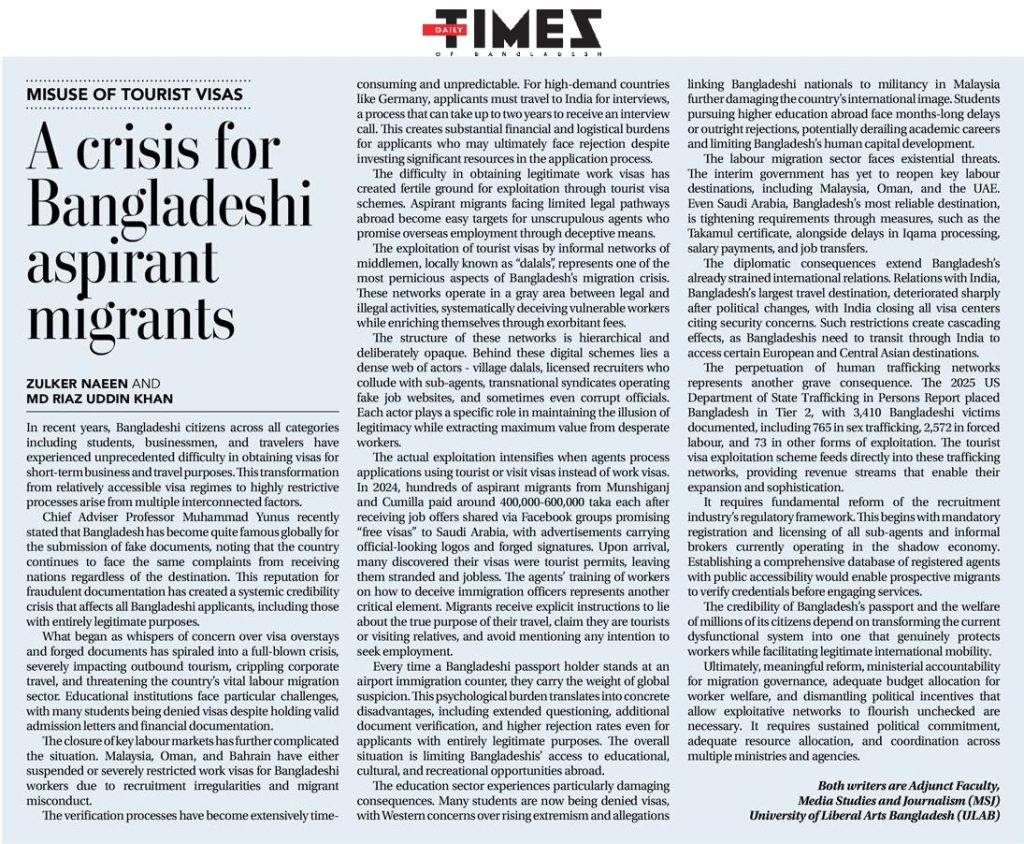
“Bangladeshi Passport” by Moin Uddin is licensed under CC BY-NC 2.0. Visit the link to view a copy of this license.

This article, jointly written by Zulker Naeen and Md. Riaz Uddin Khan

In recent years, Bangladeshi citizens across all categories, including students, businessmen, and travellers, have experienced unprecedented difficulty in obtaining visas for short-term business and travel purposes. This transformation from relatively accessible visa regimes to highly restrictive processes arises from multiple interconnected factors.

Chief Adviser Professor Muhammad Yunus recently stated that Bangladesh has become quite famous globally for the submission of fake documents, noting that the country continues to face the same complaints from receiving nations regardless of the destination. This reputation for fraudulent documentation has created a systemic credibility crisis that affects all Bangladeshi applicants, including those with entirely legitimate purposes.

Misuse Of Tourist Visas: A crisis for Bangladeshi aspirant migrants

The electronic version of the article, retrieved from the website

Read more by clicking the original link of the article.

Originally published at Daily Times of Bangladesh on December 28, 2025.

About this insight

This opinion is based on ongoing research into digital and financial literacy among Bangladeshi migrant workers.

Bridging Research & Practice in Disinformation Studies and Digital Citizenry

Airport turnback crisis jeopardising Bangladeshi workers’ dreams

0
Digital recruitment scams
Digital recruitment scams: A nightmare for thousands of Bangladeshi migrants

This article, jointly written by Md. Riaz Uddin Khan and Zulker Naeen.

The dream of working abroad has become a nightmare for thousands of Bangladeshi migrants. They arrive at foreign airports with valid visas, only to be interrogated, detained, and sent back home on the next available flight. This growing crisis of airport turnbacks and exploitation under tourist visas is not just damaging individual lives but also destroying Bangladesh’s global reputation. The problem has spread across Southeast Asia, the Middle East, and beyond, with immigration authorities becoming increasingly suspicious of Bangladeshi travellers.

Read more by clicking the original link of the article.

Originally published at Daily Times of Bangladesh on December 21, 2025.

About this insight

This opinion is based on ongoing research into digital and financial literacy among Bangladeshi migrant workers.

Bridging Research & Practice in Disinformation Studies and Digital Citizenry

What’s behind the growing anti-immigrant discourse around stateless Rohingya in India

0
Root-Cause-Analysis_Bangladeshi-Rohingya-Author-Illistration-
Root causes of anti-immigrant narratives

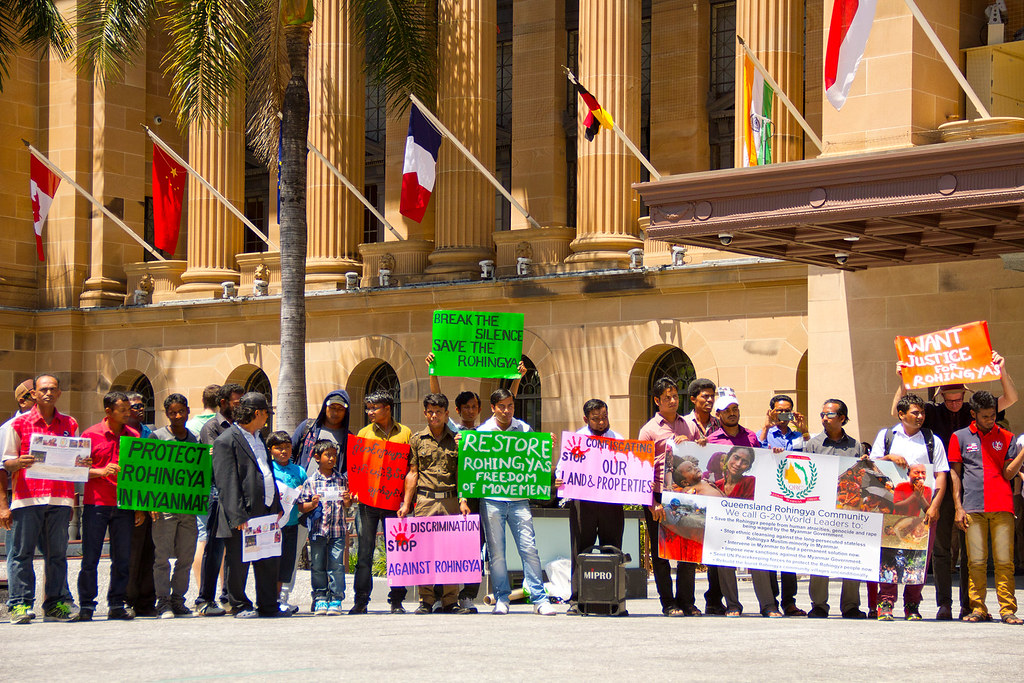
Misinformation about Rohingya refugees often starts in Myanmar and Bangladesh, then spreads across borders and shapes public opinion throughout South Asia. Images and videos from refugee camps in Bangladesh are reused in anti-immigrant narratives against the Rohingya, stateless Muslim refugees who have been forced to flee Myanmar due to an ongoing genocide and oppression against them.

What’s behind the growing anti-immigrant discourse around stateless Rohingya in India

Rohingya Protesters pushing for change in Myanmar at the G20 in Brisbane, Australia. Image via Flickr by Andrew MercerCC BY-NC-SA 2.0.

Originally published at Global Voices in December 2025.

Bridging Research & Practice in Disinformation Studies and Digital Citizenry

Safeguarding migrant workers: A call for prioritizing digital financial literacy

0
Digital Financial Literacy
Safeguarding migrant workers: A call for prioritizing digital financial literacy

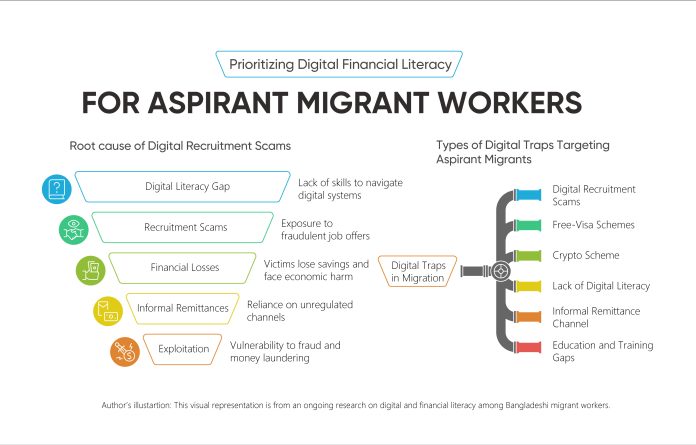
The dreams of thousands of Bangladeshi migrants have become a harsh reality — turning migration journeys into digital traps. Unfortunately, digital platforms that once promised safer routes to overseas work — job portals, messaging apps, and social media pages — now serve as the front doors to sophisticated fraud networks.

Multiple reports from 2024 and 2025 indicate that digital recruitment scams have evolved significantly, moving far beyond simple fraud into complex operations. Criminal organisations had used fake job offers to lure workers to locations where they were then coerced into participating in further scam operations, creating layers of victimisation.

Read More

Originally published at Dhaka Tribune in December 2025

When dreams meet digital recruitment scams: Bangladeshi workers in crisis

0
Migrants
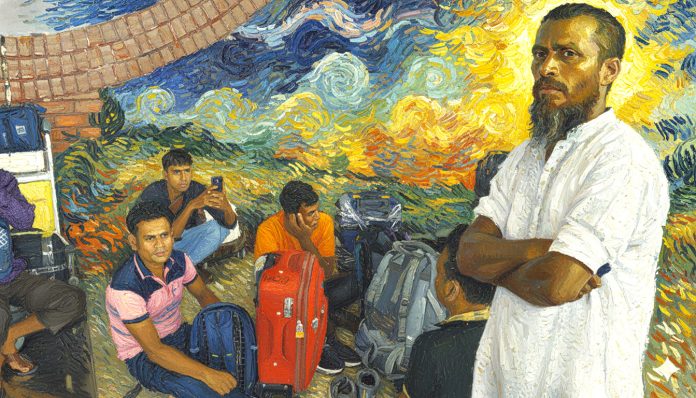
A migratory worker waits for his flight at Dhaka International Airport. Image via Wikipedia by Faisal Akram. CC BY-SA 2.0.

In the dim glow of his smartphone screen, the job advertisement seems perfect. Good salary. Reputable company. The application process is deceptively simple. A young man in rural Bangladesh reads it again, his heart racing with hope. He cannot yet see that this moment — this single click — may decide whether his family’s sacrifices lead to prosperity or unmanageable debt.

Bangladeshi migrant workers have always been vulnerable to fraud, but digital technology has transformed the scale and speed of deception. Fake recruitment schemes, online betting traps, and identity theft now reach even remote rural villages of Bangladesh through social media, mobile apps, and messaging platforms.

Read the full article, published at Global Voices on 30 November 2025.

Stages of Misinformation: An Analysis of Digital Deception across the Migrant Lifecycle in Bangladesh

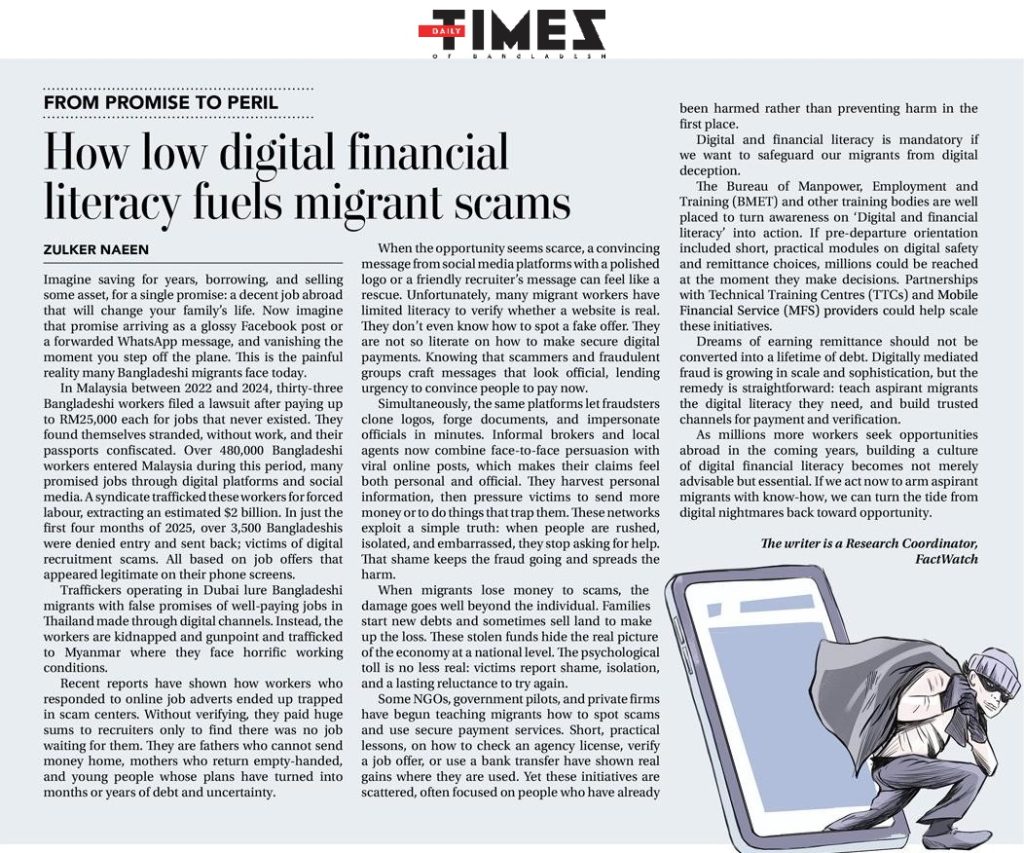
How low digital financial literacy fuels migrant scams

0
Digital Deception and Migration Journey

Digital and financial literacy is mandatory if we want to safeguard our migrants from digital deception. When migrants learn simple habits, how to verify a website, how to refuse pressure to pay into a personal account, and how to use reputable remittance services, they become harder targets.

When migrants lose money to scams, the damage goes well beyond the individual. Families start new debts and sometimes sell land to make up the loss. These stolen funds hide the real picture of the economy at a national level. The psychological toll is no less real: victims report shame, isolation, and a lasting reluctance to try again. In short, low digital and financial literacy does not just cost money; it costs future opportunity.

How low digital financial literacy fuels migrant scams

Electronic version of this published report, extracted from the website

Read more by clicking the original link of the article.

Originally published at Daily Times of Bangladesh on November 27, 2025.

About this insight

This opinion is based on ongoing research into digital and financial literacy among Bangladeshi migrant workers.

Bridging Research & Practice in Disinformation Studies and Digital Citizenry

Stages of misinformation: An analysis of digital deception across the migrantion process in Bangladesh

0
Digital Deception and Migration Journey

The migration journey of Bangladeshi workers is increasingly mediated through informal networks that expose prospective migrants to misinformation, deception, and exploitation.

Despite rising reliance on online recruitment and remittance systems, little is known about how misleading information propagates across the migration lifecycle.

Building on recent evidence of digital recruitment scams and pervasive “free-visa” schemes, this study investigates how misinformation is produced and circulated, which actors exploit digital and interpersonal channels, and which digital-literacy deficits most strongly mediate harm.

This study contributes to migration scholarship by conceptualising a stage-based framework that links digital deception to tangible migrant harms.

Importantly, findings will inform policy and practice: strengthening digital literacy curricula, verification mechanisms, and harmonising regulatory oversight across recruitment pipelines can mitigate the harms documented.

Finally, the research calls for rigorous evaluations of digital-literacy interventions and cross-sector collaborations to foster safer migration pathways.

error: Content is protected !!