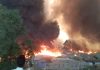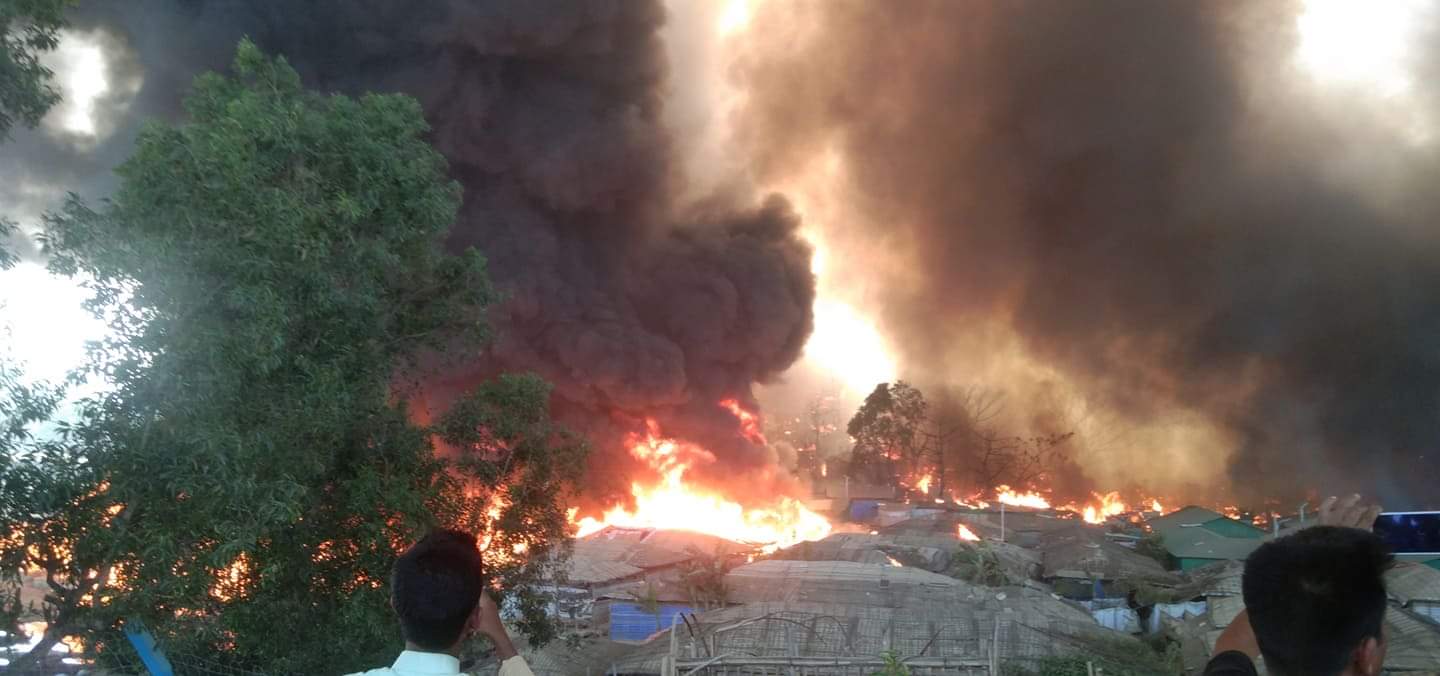
March 2021 Rohingya refugee camp fire by Rocky Masum is licensed under CC BY-SA 4.0.
Abstract
Since August 2017, approximately one million Rohingya refugees fleeing genocidal violence in Myanmar established the world’s largest and most densely populated refugee settlement in Cox’s Bazar, Bangladesh. Within this protracted displacement context, fire incidents have emerged as a defining humanitarian catastrophe, with 2,425 documented fires between May 2018 and December 2025 affecting over 100,000 individuals and destroying more than 20,000 shelters.
This investigation is structured around a primary research question: What are the root causes of fire incidents in Rohingya refugee camps in Cox’s Bazar, Bangladesh, and how do structural-accidental fires differ from deliberate arson in terms of causation, frequency, and impact?
The primary objective of this research is to systematically document, analyse, and explain the root causes and perpetrators of fire incidents in the Rohingya refugee camps of Cox’s Bazar, Bangladesh, between 2017 and 2026, with particular emphasis on distinguishing between structural-accidental fires and deliberate arson orchestrated by armed groups.
This research employs a mixed-methods approach combining qualitative systematic literature review of 55 primary and secondary sources, critical discourse analysis of government investigation reports and humanitarian agency assessments, spatial-temporal mapping of fire incidents across camp blocks and seasons, and triangulation of English-language international reporting with Bangla-language national media coverage to capture both external and domestic framings of the crisis.
A sampling strategy utilising purposive and snowball techniques was employed to identify all accessible reports that met the inclusion criteria: direct coverage of fire incidents in Cox’s Bazar camps, published between 2017 and 2026, featuring causal analysis beyond mere incident description.
This research not only extends conflict studies literature on the use of arson as a weapon in contested governance spaces but also provides evidence-based recommendations for humanitarian actors regarding the inadequacy of technical fire safety interventions that have failed to address the governance dimension.
Ultimately, the study highlights the most fundamental protection concern—the right to shelter that does not burn—remains unaddressed after eight years of encampment, severe inadequacies of temporary humanitarian responses to what have become permanent displacement situations.