By Guest Contributor
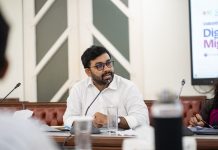
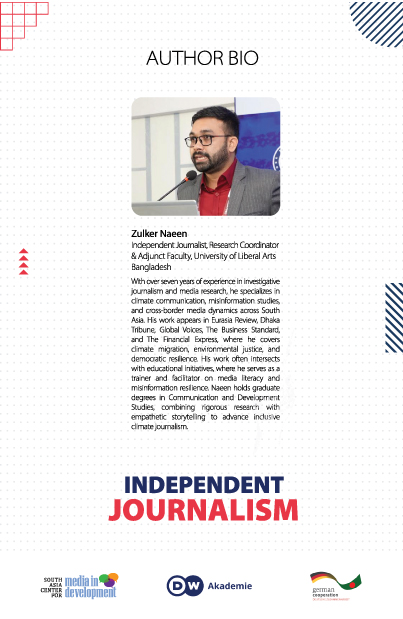
When Zulker Naeen stepped away from daily reporting last year to co-author a training module on independent journalism, he carried eight years of field experience that couldn’t be found in any textbook. He is interdisciplinary.
His credentials included investigations into climate, environment, migration, gender, refugees, geopolitics, cricket diplomacy, digital literacy, and cross-border reporting on environmental justice, as well as navigating the pressures and maintaining editorial independence in Bangladesh’s complex media environment.
His work appears in Eurasia Review, Dhaka Tribune, Global Voices, The Business Standard, and The Financial Express, where he covers climate migration, environmental justice, and democratic resilience. His work often intersects with educational initiatives, where he serves as a trainer and facilitator on media.
Now, that experience has been distilled into a structured curriculum. The “Independent Journalism” module, developed under the Journalism of the Future Fellowship Program, launched this month as part of a broader effort to rebuild public trust in media through better-trained practitioners.
“We’re seeing graduates from journalism programs who can write perfectly structured news stories but struggle when sources dry up or when political pressure arrives,” Naeen explains. “This module addresses what happens between the classroom theory and the newsroom reality.”
The initiative emerges from a partnership between the South Asia Centre for Media Development and Deutsche Welle Academy, in response to what media researchers have documented as a decline in confidence in traditional news outlets across the region. A 2023 Reuters Institute study found that trust in news media among Bangladeshi respondents fell to thirty-eight per cent, down from forty-six per cent two years earlier.
The module targets a deliberately broad audience—recent graduates exploring journalism careers, content creators seeking to transition from social media influence to credible reporting, activists wanting to adopt rigorous journalistic methods, and professionals from other fields bringing expertise into media work.
Rezwan Islam, South Asia Editor, Global Voices, points to changing newsroom compositions. “Ten years ago, nearly everyone in our newsroom had a journalism degree. Now our strongest investigators include a former environmental scientist, an economist, and someone who worked in NGO advocacy. They bring domain expertise we desperately need, but they require structured training in journalistic methodology.”
“Independence doesn’t mean isolation,” Naeen emphasises. “It means having the skills and ethical framework to pursue stories regardless of institutional constraints. That requires both technical competence and understanding how to build sustainable practices.”
The module’s development process involved consultations with working journalists, media scholars, and civil society practitioners. This participatory approach aimed to ensure actual practice conditions rather than idealised versions of journalism work.
The module represents one component of the broader Journalism of the Future program, which includes specialised training in data journalism, fact-checking, and multimedia storytelling. Together, these domains respond to documented skills gaps in Bangladesh’s journalism education landscape.
For Zulker, the transition from practising journalist to curriculum developer has meant translating instinctive knowledge into teachable frameworks. “In the field, you develop reflexes—how to verify information quickly, how to protect sources, how to maintain independence under pressure. The challenge was making those reflexes conscious and systematic so they could be taught.”
The module’s completion arrives as Bangladesh’s media sector faces both opportunities and pressures. Digital platforms have lowered barriers to entry, enabling new voices and models.
Whether this curriculum can meaningfully shift journalism practice in Bangladesh remains to be tested. But its existence reflects growing recognition that rebuilding public trust in media requires investing in the skills and ethical frameworks of those producing journalism—regardless of their backgrounds or institutional affiliations.
“We’re not trying to create identical journalists,” Naeen concludes. “We’re trying to establish shared standards for rigour, ethics, and independence that can apply across different types of media work. If we can do that, we strengthen the entire information ecosystem.